

The allied health workforce plays an increasingly vital role in supporting the broader healthcare ecosystem. Beyond direct patient care, administrative functions are critical for the smooth operation and financial stability of medical facilities. Medical coding and billing professionals, classified under the umbrella of medical records specialists by the U.S. Bureau of Labor Statistics (BLS), are at the forefront of this administrative demand. These non-clinical healthcare roles are essential for ensuring provider reimbursement integrity and maintaining the revenue cycle’s resilience. Their expertise directly impacts a healthcare organization’s ability to provide services and manage its resources effectively.
The growing demand for these specialists highlights a significant area of opportunity within the allied health sector. As the healthcare landscape becomes more complex, with evolving regulations and coding systems, the need for skilled professionals who can accurately translate medical services into billable codes only intensifies. This creates a stable and growing career path for individuals seeking to contribute to healthcare without direct patient interaction.
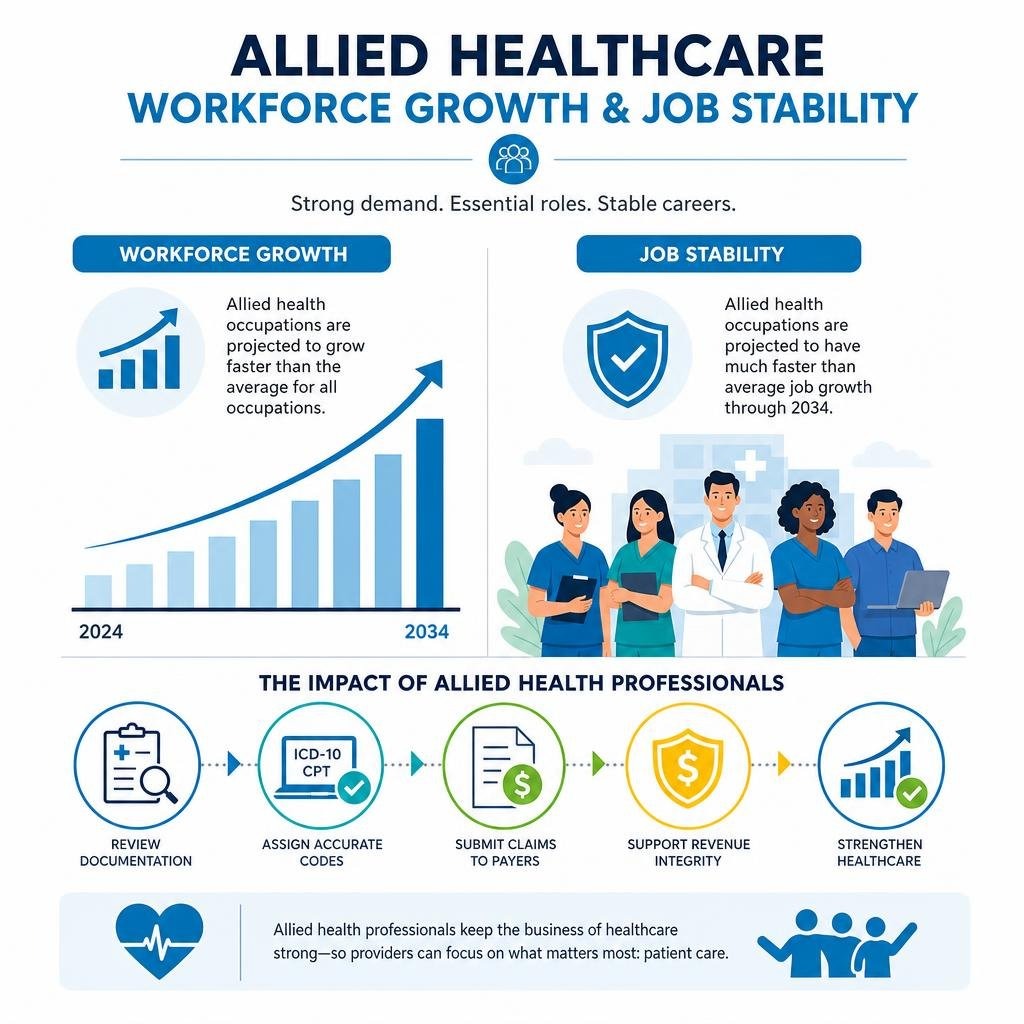
Non-Clinical Roles in Revenue Cycle Management
Medical records specialists are the unsung heroes of the healthcare revenue cycle. Their work involves a meticulous process of reviewing patient records, clinical documentation, and physician notes to assign standardized diagnostic and procedural codes. These codes, such as those from the ICD-10 (International Classification of Diseases, 10th Revision) and CPT (Current Procedural Terminology) systems, form the universal language of healthcare billing. Medical billing professionals then use these codes to prepare and submit claims to insurance companies, managing the entire reimbursement process from initial claim submission to follow-up and denial management.
The integrity of this process is paramount. Accurate coding ensures that healthcare providers receive appropriate reimbursement for the services rendered, preventing revenue loss and potential compliance issues. Conversely, errors can lead to claim denials, delayed payments, and even legal repercussions. This precision demands a deep understanding of medical terminology, anatomy, physiology, and complex coding guidelines, making these roles highly specialized and indispensable to modern healthcare operations.
Career Mobility and Accelerated Educational Pathways
One of the most appealing aspects of a career in medical billing and coding is the accessibility of its educational pathways. Unlike many healthcare professions that require extensive multi-year degrees, entry into this field can often be achieved through certificate programs or associate degrees, with many programs offering affordable allied health training designed for accelerated completion. For instance, some comprehensive online training models can be completed in as little as 12 months, providing a relatively low barrier to entry into a stable and in-demand profession.
These programs equip aspiring professionals with the foundational knowledge in medical terminology, human anatomy, and the intricacies of various coding systems. They also cover essential billing procedures, compliance regulations, and the use of industry-standard software. This efficient training model allows individuals to transition into the healthcare workforce quickly, often leading to immediate employment opportunities upon certification. The emphasis on practical, job-ready skills ensures that graduates are well-prepared to meet the administrative demands of diverse healthcare settings.
Medical Billing and Coding Compensation Benchmarks in 2026
Understanding the earning potential in medical billing and coding is crucial for those considering this career path. As of August 2026, the national median salary for medical billing and coding professionals, categorized as medical records specialists by the BLS, stands at a robust $50,250 annually. This translates to an hourly wage of approximately $24.16. However, this median figure represents a broad spectrum of earnings, with significant variations based on factors such as experience, location, certifications, and employer type.
The salary distribution for these professionals is quite wide, reflecting diverse skill levels and responsibilities within the field. The lowest 10% of earners typically make less than $35,780 per year, often representing entry-level positions or those in lower-paying regions or settings. Conversely, the top 10% of medical billing and coding professionals can command salaries exceeding $80,950 annually, showcasing the substantial earning potential for experienced and highly credentialed specialists. This range underscores the importance of strategic career development and continuous learning to maximize income.

Optimizing Certification Paths in Allied Healthcare Workforce Training
Certification is arguably the single most impactful factor in boosting earning potential within medical billing and coding. Industry-recognized credentials, particularly from organizations like the American Academy of Professional Coders (AAPC) and the American Health Information Management Association (AHIMA), are highly valued by employers. They signify a professional’s validated expertise and commitment to industry standards.
For instance, holding a Certified Professional Coder (CPC) credential from AAPC can significantly elevate a professional’s salary. Data from 2026 indicates that CPC-certified individuals earn a median salary of approximately $67,147, representing a substantial 33.6% premium over the national baseline for uncertified professionals. Other specialized certifications also command impressive figures: Certified Inpatient Coders (CIC) average around $74,475, while Certified Risk Adjustment Coders (CRC) earn about $71,747.
The concept of “stackable credentials” further amplifies earning potential. Professionals who pursue and maintain multiple certifications often see their salaries climb even higher. For example, those with two AAPC certifications earn an average of $64,890, and those with three certifications can reach an average of $70,608. This demonstrates a clear pathway for continuous professional development directly linked to increased compensation, making strategic certification a key investment for career growth.
Employer Setting and Industry Pay Disparities
The type of healthcare setting where a medical billing and coding professional works also significantly influences their salary. Different environments present varying levels of complexity, patient volume, and financial structures, which in turn affect compensation.
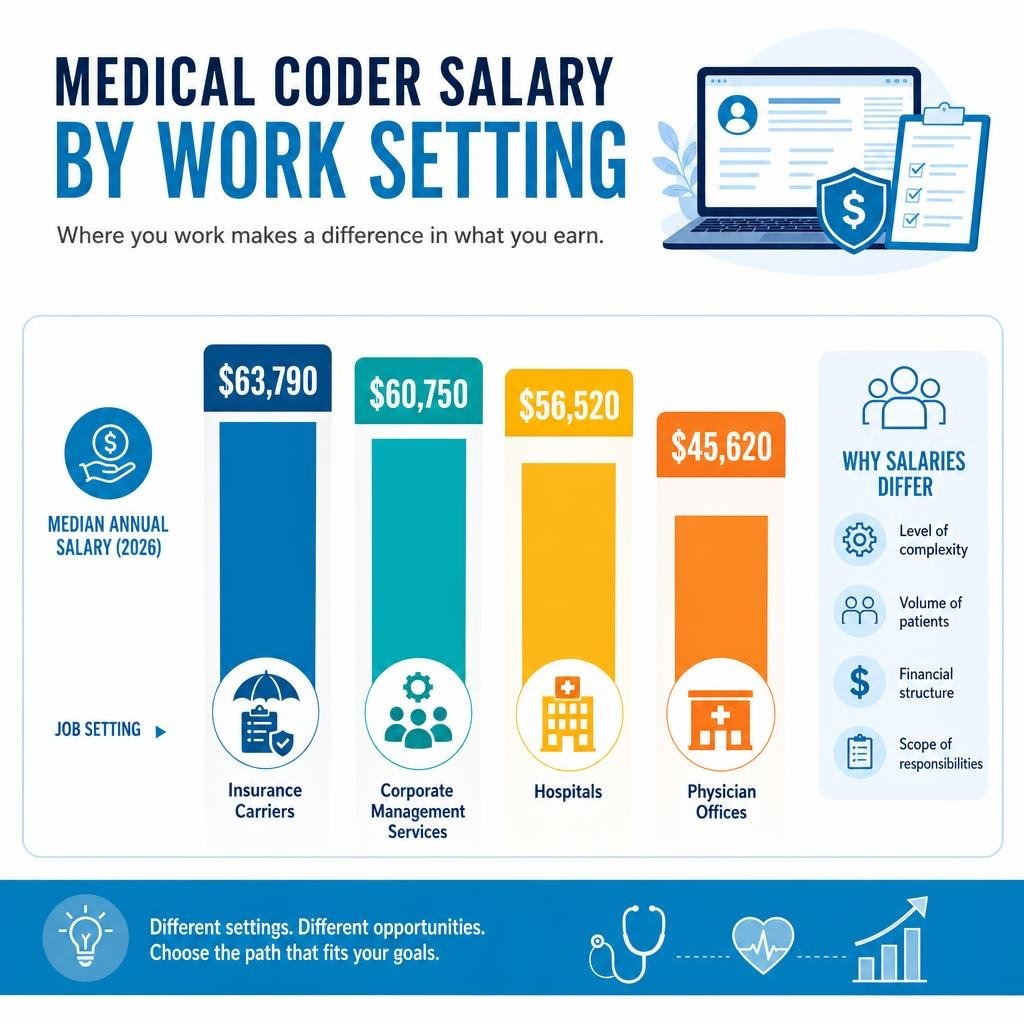
Historically, hospital health systems have offered higher median salaries compared to smaller outpatient physician practices. In 2026, medical coders and billers working in hospitals earn a median salary of approximately $56,520, reflecting the intricate nature of inpatient coding and the larger scale of operations. In contrast, those in physician offices typically earn around $45,620.
Beyond direct patient care facilities, other industry sectors also employ medical records specialists, often at competitive rates. Insurance carriers, for example, value the expertise of these professionals for claims processing and auditing, offering a median annual wage of $63,790. Similarly, those working for corporate management services in healthcare can expect around $60,750. This diversity in employer types provides flexibility for professionals to align their career aspirations with specific industry segments that offer attractive compensation packages.
Factors Influencing Salary Trajectories and Career Growth
While national averages and certifications provide a baseline, several other factors play a crucial role in shaping a medical billing and coding professional’s salary trajectory and overall career growth. These include accumulated experience, geographic location, and the evolving landscape of remote work opportunities. Understanding these dynamics allows professionals to make informed decisions about their career path and maximize their earning potential over time.

Geographic Pay Differences and Local Purchasing Power
Location is a powerful determinant of salary in medical billing and coding, much like in many other professions. State-level wage variance can be substantial, often correlating with the local cost of living and the demand for healthcare services. For instance, some of the highest-paying states for medical billing and coding professionals in 2026 include California ($68,230), Washington ($67,480), New York ($67,200), and Hawaii ($65,590). Massachusetts also stands out with an average of $67,260.
However, it’s crucial to consider the “real purchasing power” rather than just the nominal salary. While states like Hawaii offer high salaries, their exceptionally high cost of living means that a higher paycheck might not translate into greater disposable income. Conversely, professionals in states with lower nominal salaries but also a significantly lower cost of living might find their earnings stretch further. This concept of geographical arbitrage, where one lives in a low-cost area while earning a salary benchmarked to a higher-cost region, is increasingly relevant, especially with the rise of remote work.
The Shift to Remote Work in Allied Healthcare Workforce Training
The medical billing and coding field has embraced remote work more readily than many other healthcare professions. This shift has profound implications for both job opportunities and salary structures. As of 2026, a significant 80.2% of medical records specialists work remotely or in a hybrid arrangement, with a substantial 64.8% working fully remotely. This trend has not only expanded access to jobs for individuals in various geographic locations but has also begun to compress traditional state-by-state salary disparities.
Remote work offers unparalleled flexibility, allowing professionals to work from home and often for employers located anywhere in the country. This can be particularly advantageous for those residing in lower cost-of-living areas, who can access higher-paying positions typically found in major metropolitan or high-cost states.
For those working for Revenue Cycle Management (RCM) vendor platforms, remote work can also come with productivity incentives, potentially adding a 5% to 12% premium over in-house rates. This model rewards efficiency and accuracy, further motivating professionals to hone their skills. The expansion of remote opportunities means that professionals are no longer limited by their local job market, opening up a broader array of choices and potentially higher earning opportunities, irrespective of their physical location.
Frequently Asked Questions About Allied Healthcare Workforce Training
We often encounter questions about the financial prospects and career trajectory in medical billing and coding. Here, we address some of the most common inquiries to provide clarity for prospective and current professionals.
What is the national median salary for medical coding and billing professionals in 2026?
As of August 2026, the national median annual salary for medical coding and billing professionals, a role often classified under medical records specialists by the BLS, is $50,250. This translates to an hourly wage of approximately $24.16. This is a median figure, with salaries ranging from the 10th percentile, earning around $35,780 annually, to the 90th percentile, where professionals can earn over $80,950 per year. These figures highlight the significant potential for salary growth with experience and specialized skills.
How significantly do professional certifications increase medical coder earnings?
Professional certifications are a powerful lever for increasing earnings in medical coding and billing. Data consistently shows a substantial salary premium for certified professionals compared to their uncertified peers. For instance, holding a Certified Professional Coder (CPC) credential can lead to a median salary of $67,147, representing an impressive 33.6% increase over the national baseline. Furthermore, pursuing multiple certifications, often referred to as “stackable credentials,” can lead to even higher earnings. Professionals with two or more certifications can average around $74,557 annually, demonstrating that continuous professional development through certification directly translates into higher compensation.
How does remote work affect compensation for allied health specialists?
Remote work has become a defining feature of the medical billing and coding profession, with 64.8% of medical records specialists working fully remotely as of 2026. This shift has had a multifaceted impact on compensation. While some employers may adjust salaries based on an employee’s local cost of living, many remote positions, particularly with larger RCM vendors, offer national pay scales. This allows professionals in lower cost-of-living areas to access higher-paying opportunities. Additionally, remote roles, especially in RCM companies, often include productivity bonuses, which can add a 5% to 12% premium to a professional’s base salary, rewarding efficient and accurate work. This geographical arbitrage and performance-based pay structure make remote medical billing and coding a highly attractive and potentially lucrative career path.
Conclusion
The field of medical coding and billing stands as a critical pillar in the healthcare industry, essential for revenue integrity and the efficient functioning of medical practices. As we navigate the complexities of healthcare in 2026, the demand for skilled administrative professionals continues to grow, underscoring the stability and promising long-term career outlook for these roles. Investing in comprehensive allied health workforce training not only addresses existing shortages but also empowers individuals with valuable skills that lead to competitive salaries and diverse career pathways. With clear benchmarks for compensation, the significant impact of certification, and the expanding opportunities presented by remote work, medical coding and billing offers a rewarding and dynamic career for those looking to make a vital contribution to healthcare from an administrative perspective.
- 6 Bathroom Renovation Resources Spokane Homeowners Can Use for Safer, Easier-Care Spaces
- How R&D Center Helps People Find Personalized Drug Treatment in Philadelphia, Pennsylvania
- How Play Builds School Readiness for Preschoolers in Greensboro, North Carolina
- How to Choose the Right Way to Sell a House in Fayetteville, North Carolina
- Navigating Mental Health Resources and Therapy Options