

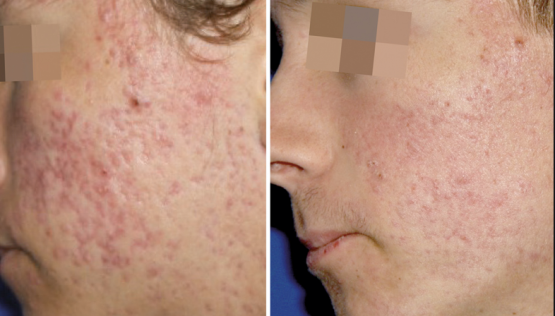
PRP therapy is a minimally invasive treatment option for improving skin texture and promoting natural healing. It supports collagen production and tissue repair by leveraging the body’s repair capabilities. Here’s a closer look at the benefits of PRP for acne scars:
Supporting Skin Renewal
Platelet-Rich Plasma therapy works at the cellular level to encourage the body to heal itself. The biological activity stimulated by PRP is multifaceted and involves several key processes:
- Collagen Induction: The growth factors released by platelets stimulate the cells responsible for producing collagen.
- Angiogenesis: It promotes the formation of new blood vessels, improving circulation and oxygenation to the treated tissues.
- Cellular Turnover: The treatment accelerates skin cell turnover, replacing damaged or scarred tissue with healthy new cells for a smooth texture.
- Tissue Regeneration: It enhances the tissue’s regenerative capacity, leading to comprehensive skin improvements.
Rather than addressing surface-level issues, PRP targets the underlying structural deficiencies that characterize acne scarring.
Treating Acne Scars
Acne scars are caused by a loss of collagen during the healing process of acne lesions. This deficit leads to skin depressions. PRP is effective for these types of scars because it directly addresses the collagen deficiency and kickstarts the production of new collagen and elastin fibers. The improved skin texture and tone resulting from increased cell turnover help to blend the scarred areas with the surrounding healthy skin.
Beyond texture, PRP can also assist with post-inflammatory hyperpigmentation, the dark spots often left behind by acne. Skin cell renewal helps fade these pigmented areas more quickly than the body would on its own. Combining PRP with other treatments, such as microneedling, often yields better results. Microneedling creates controlled micro-injuries in the skin, creating channels for the platelet-rich plasma to penetrate deeper into the dermis.
Exploring PRP Treatment
A PRP session is performed in a clinical setting. The typical PRP treatment protocol involves the following stages:
- Blood Collection: A medical professional draws a small amount of blood from the patient’s arm, similar to a routine blood test.
- Centrifugation: The drawn blood is placed in a centrifuge machine, which spins at high speeds to separate the plasma and platelets from the red blood cells.
- Preparation: The platelet-rich plasma is extracted and prepared for injection or topical application.
- Application: The provider applies PRP to the target areas, either by direct injection into the scars or topically during a microneedling session to enhance absorption.
Patients are usually advised to avoid wearing makeup and to protect their skin from the sun for a few days following the treatment.
Achieving Long-Term Results
Recovery from PRP therapy is generally quick. The redness typically subsides within one to three days. Because PRP relies on natural biological processes, results are not instantaneous. Improvement is gradual, with visible changes often appearing within a few weeks as new collagen develops.
For optimal results, a series of treatments is usually recommended. Depending on the severity of the scarring, providers may suggest three to six sessions spaced four to six weeks apart. Long-term benefits of PRP for acne scars include durable improvements in skin texture and firmness.
Book Your PRP Session Today
PRP therapy is a significant advancement in treating acne scars, offering a natural and effective solution for skin restoration. It addresses the root causes of scarring by leveraging the body’s own healing capabilities to deliver smooth and radiant skin. If you are struggling with the aftermath of acne and seeking a non-surgical remedy, contact a qualified aesthetic specialist near you to book your PRP session today.