

Key Takeaways
- Quick action matters when a person is unresponsive and not breathing normally.
- Call 911, begin CPR, and use an AED as soon as one is available.
- For an adult or teen who suddenly collapses, hands-only CPR is an appropriate option for untrained bystanders.
- Clear roles can help groups avoid confusion while emergency crews are on the way.
- Practice and preparation make it easier to act calmly during a real emergency.
A suspected cardiac arrest is frightening, but bystanders do not need to make a perfect medical diagnosis before acting. If a person suddenly collapses, does not respond, and is not breathing normally, call 911 and start helping. Taking an online CPR certification course before an emergency can help build the skills and confidence needed to respond quickly.
The first minutes are about getting help moving, supporting circulation with chest compressions, and using an automated external defibrillator, or AED, if one is nearby. Follow the 911 dispatcher’s instructions, stay focused on the person, and ask others nearby to take specific tasks.
How to Recognize Cardiac Arrest
Cardiac arrest is different from a heart attack. A heart attack involves blocked blood flow to part of the heart muscle, while cardiac arrest means the heart has stopped pumping blood effectively. A heart attack can sometimes lead to cardiac arrest, but the immediate bystander response is based on what you see: sudden collapse, no response to voice or touch, and absent or abnormal breathing.
Gasping, snorting, or irregular breathing are not normal breathing. Do not spend a long time trying to decide what is happening or searching for a pulse. If the person is unresponsive and only gasping, treat it as an emergency and call 911.
What to Do During the First Minute
Use a simple three-step response
- Check the area. Make sure you are not stepping into danger from traffic, fire, unstable equipment, or another immediate hazard.
- Check the person. Tap their shoulder and ask loudly, “Are you okay?”
- Call 911. Put the phone on speaker so the dispatcher can guide you while your hands remain free.
If other people are present, point to one person and say, “Call 911,” then point to another and say, “Find the AED.” Specific directions work better than asking generally whether anyone can help. Do not leave the person alone unless you must get help or retrieve the nearest AED.
How to Begin Chest Compressions
Place the person on their back on a firm, flat surface when possible. Kneel beside their chest, put the heel of one hand in the center of the chest, place your other hand on top, and keep your arms straight. Push hard and fast, allowing the chest to rise completely after each compression.
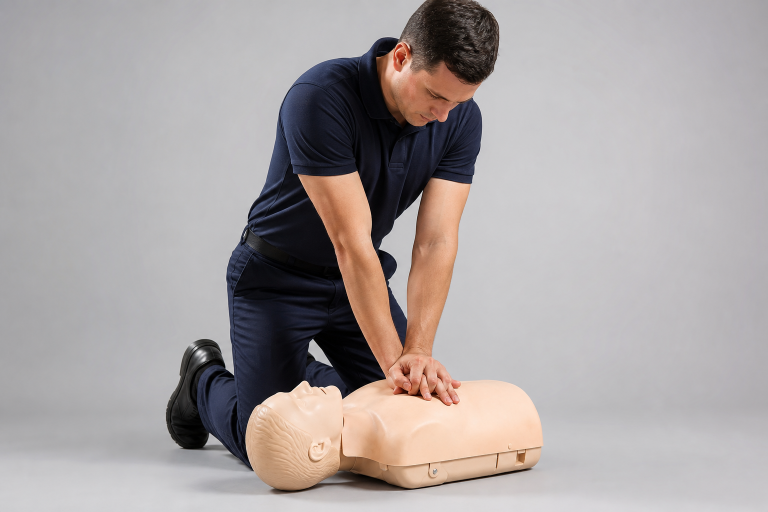
For an adult, chest compressions should generally be delivered at a rate of 100 to 120 per minute. A bystander who sees a teen or adult suddenly collapse can use hands-only CPR by continuously pushing in the center of the chest until an AED is ready, emergency professionals take over, or the person begins to show clear signs of movement or normal breathing.
Rescue breaths can be valuable in situations involving children, drowning, overdose, or breathing-related collapse, particularly when provided by someone trained to give them. If you are unsure, follow the dispatcher’s instructions. CPR cannot guarantee survival, but prompt action gives the person a better chance of receiving lifesaving care before emergency crews arrive.
When and How to Use an AED
An AED is a portable device that checks the heart’s rhythm and, when appropriate, tells the user to deliver a shock. It is designed to guide ordinary people with spoken and visual instructions, so do not wait for a medical professional if an AED is available.
- Turn on the AED as soon as it arrives.
- Expose the person’s chest and dry it if it is wet.
- Place the pads exactly as shown in the diagrams on the pads or device.
- Make sure no one is touching the person while the AED analyzes.
- If the device advises a shock, make sure everyone is clear before it is delivered.
- Resume CPR immediately when the device instructs you to do so.
Speed is especially important for younger patients. Recent research from the American Heart Association on early bystander CPR reported better outcomes when lay rescuers began CPR quickly after pediatric out-of-hospital cardiac arrest. Those findings were preliminary and focused on children, but they reinforce the importance of acting without unnecessary delay.
How to Organize a Group Response
Several willing people can help, but only if they are organized. Assign simple roles and keep communication short:
- Caller: Contacts 911, gives the exact location, and answers dispatcher questions.
- Compressor: Starts CPR and switches with another helper if fatigue affects compression quality.
- AED runner: Finds and brings the closest AED.
- Door guide: Watches for emergency crews and directs them to the scene.
For example, a workplace safety drill can assign these same roles before an emergency ever occurs. Rehearsing the process helps people avoid arguing about tasks when every second feels urgent.
What Changes When the Person Is a Child
Children and infants need age-appropriate CPR techniques, and their cardiac arrest may follow a breathing emergency, drowning, choking, or serious injury. Trained rescuers should use the child or infant CPR method they learned, including rescue breaths when appropriate. Anyone who is uncertain should call 911 immediately and follow the dispatcher’s instructions.
Schools, youth programs, and athletic organizations benefit from written emergency plans, accessible AEDs, trained staff, and regular practice. This Heart-Safe School guidance describes practical steps that can help schools prepare for a cardiac emergency.
Common Mistakes That Cause Delays
- Waiting for the person to wake up:Call 911 and act when they are unresponsive and not breathing normally.
- Checking for a pulse too long: Focus on responsiveness and breathing, then follow dispatcher guidance.
- Stopping CPR to search for supplies: Keep compressions going while another person gets the AED.
- Giving vague directions: Assign tasks to specific people.
- Being afraid of the AED: Turn it on and follow its prompts.
How Homes, Schools, and Workplaces Can Prepare
Preparation is not limited to hospitals. Identify where AEDs are located, keep access routes clear, post accurate addresses near phones, and make sure multiple people know how to call 911. Check AED supplies according to the manufacturer’s instructions, including pad and battery expiration dates.
Practice a brief emergency response drill regularly. Families can teach children how to call 911 and describe their location. Schools and workplaces can review who calls, who starts CPR, who retrieves the AED, and who meets emergency crews. A clear plan turns a chaotic moment into a sequence of useful actions: check, call, compress, and use the AED.
- After Death And Meaning: A Practical Guide To Grief, Hope, And End-Of-Life Conversations
- What to Do in the First Few Minutes of a Suspected Cardiac Arrest
- 6 Leading Dental Implant Providers In Palm Beach County
- 7 Downtown Chicago Hotels For Rooftop Views, Events, And Memorable Stays
- A Practical Guide to Safer, Smarter Food Storage at Home