

Joint pain and immobility affect countless individuals, disrupting daily routines and diminishing quality of life. When standard physical examinations or X-rays fail to provide a complete picture of what is happening beneath the surface, physicians often turn to advanced imaging technology. Magnetic resonance imaging (MRI) stands as a powerful tool in modern orthopedics, offering a detailed view into the complex structures of the human body without the use of ionizing radiation.
What Is an MRI For?
Physicians use MRI scans to examine various musculoskeletal conditions that other imaging methods might miss. While X-rays are excellent for visualizing bone fractures, they may struggle to show soft tissue damage clearly. An MRI excels in this area and is a rational choice for evaluating the complex anatomy of joints. One primary use involves the assessment of ligament and tendon injuries. An athlete with a suspected tear in the anterior cruciate ligament (ACL) of the knee will likely undergo an MRI. Rotator cuff tears in the shoulder are readily visible on these scans.
Beyond traumatic injuries, doctors utilize MRI to detect chronic conditions. Arthritis can cause subtle changes in cartilage and bone marrow that only high-resolution imaging can detect. This early detection allows for interventions that might slow disease progression. An MRI is instrumental in identifying spinal issues, such as herniated discs, which can cause referred pain in the extremities. It also serves as a key diagnostic tool for identifying tumors within the musculoskeletal system.
How Does It Work?
The technology behind MRI relies on powerful magnets and radio waves rather than radiation. The human body is composed largely of water. When a patient enters the MRI machine, the strong magnetic field forces the protons in water to align with that field. A radio frequency current is pulsed through the patient, and this pulse stimulates the subatomic particles in water. The MRI sensors are able to detect the energy released as the protons realign with the magnetic field.
Different tissues can release energy at different rates and intensities. The MRI computer processes these signals to create detailed, cross-sectional images of the body. Fat, water, muscle, and bone all appear distinct on the resulting scan, and this differentiation allows radiologists to distinguish between healthy tissue and diseased or damaged areas. The scanner takes images in thin slices, which the computer can then compile into visual representations. This gives the physician a comprehensive view of the joint from multiple angles.
What Should You Expect?
Undergoing an MRI is a non-invasive and painless procedure, though it does require preparation and patience. Before the exam, patients must remove all metal objects, including jewelry, watches, and hairpins, as the powerful magnet can attract these items or cause them to heat up. Patients with certain medical implants, such as pacemakers or cochlear implants, must inform their technician beforehand, as some devices are not compatible with the machine.
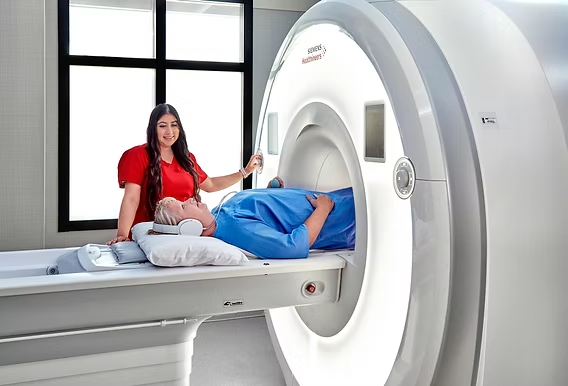
During the scan, the patient lies on a table that slides into the large, tube-like scanner. Staying perfectly still is necessary, as movement can blur the images and reduce their diagnostic value. The machine makes loud tapping or thumping noises while it captures images. Most patients can return to normal activities immediately following the exam.
Consult an Imaging Specialist
Interpreting MRI results requires specialized training and expertise. A radiologist, a physician specifically trained to analyze medical images, will review the scans and generate a report for the referring doctor. This collaboration between the radiologist and primary care physician makes sure the findings are integrated into the patient’s overall health context.
- Simple Steps to Improve Financial Health
- Understanding the Different Types of Dentures Available Today
- How To Personalize Your Wedding Catering for a Unique Celebration
- Tips for Parents in Finding Pediatric Dentistry
- Looking for a smart way to upgrade your kitchen on a budget? Consider replacement kitchen doors