

Key Takeaways
- The highest-strength alloy steel is not automatically the right material for every component.
- Start with the part’s load, wear, speed, temperature, environment, and likely failure mode.
- Heat treatment, stock size, and final hardness can be as important as the nominal grade.
- Machining, distortion control, finishing, and corrosion protection should be planned before material is ordered.
- A complete purchase specification helps prevent delays, rework, and incorrect material substitutions.
Start With The Job, Not The Grade
Choosing alloy steel begins with understanding what the finished part must do. A fixture that holds a component in place under steady load has very different needs from a rotating shaft, wear sleeve, gear blank, punch, or high-impact machine pin. Selecting a grade solely because it has a high strength value can add cost and machining difficulty without improving service life.
Instead, define the operating conditions first, then choose a grade and condition that fit them. Consider load direction, impact, repeated stress, sliding contact, temperature, lubrication, moisture, and required tolerances. For a practical starting point on available material options and forms, learn more here before finalizing a specification.
What Makes Alloy Steel Different?
Alloy steel is steel made with additional elements that are selected to influence performance. Common alloying elements include chromium, nickel, molybdenum, manganese, silicon, and vanadium. Depending on the chemistry and processing route, these additions can support strength, toughness, hardenability, wear resistance, or performance at elevated temperatures. The broader definition and common alloy steel familiesare explained in this overview of alloy steel composition and properties.
However, chemistry does not tell the whole story. A part’s actual properties also depend on heat treatment, cooling rate, section thickness, surface condition, and the hardness specified after processing. Two parts made from the same grade can perform differently if one is supplied annealed and the other is quenched and tempered.
Match The Steel To The Main Load
- Static loads: Prioritize yield strength and stiffness when the concern is permanent bending or deformation.
- Impact loads: Give greater weight to toughness and resistance to cracking, especially where sudden shock is possible.
- Repeated loads: Review fatigue performance, surface finish, stress concentrations, alignment, and geometry.
- Sliding contact: Focus on hardness, lubrication, surface finish, and wear resistance.
- Rotating parts: Consider straightness, balance, fatigue loading, hardness depth, and dimensional stability.
Strength Is Only One Part Of The Decision
Several material properties are often discussed together, but they solve different problems:
- Strength is the ability to resist deformation or failure under applied load.
- Hardness is resistance to indentation and can be important for wear surfaces.
- Toughness is the ability to absorb energy before fracturing.
- Hardenability describes how effectively a steel can develop hardness through a section during heat treatment.
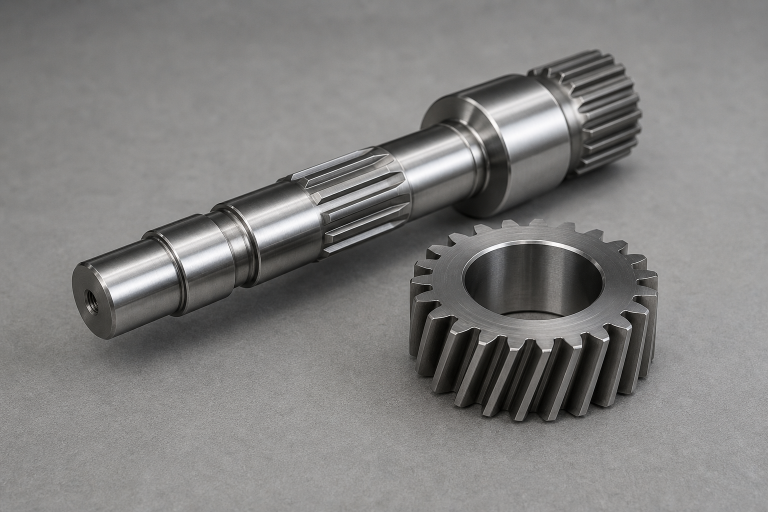
A very hard part may resist abrasion well but be less suitable for severe impact. Conversely, a tougher part may survive shock better while requiring a hardened surface in locations exposed to friction. Section size matters because thicker components may not cool or transform uniformly during heat treatment.
Choose The Right Heat-Treatment Strategy
Through-hardening is useful when a component needs relatively consistent properties across its cross-section. Surface-hardening approaches are often better when the part needs a wear-resistant exterior and a tougher core. Common options include quenching and tempering, induction hardening, carburizing, and nitriding. Each process affects hardness depth, distortion risk, machining allowances, and inspection requirements. A basic explanation of heat-treatment methods can help teams discuss the processing route more clearly.
The best treatment depends on where the load travels through the part. A shaft journal may benefit from a hard surface, while a heavily loaded structural pin may need toughness throughout much of its section. Confirm the required final hardness range and effective hardened depth before production starts.
Plan Machining Before Heat Treatment
Machining strategy should be established at the same time as material selection. Hardened steel generally requires more robust tooling, controlled cutting conditions, and close attention to heat, vibration, chip control, and surface finish. Rough machining before heat treatment can reduce cutting time after hardening, while grinding or a final finish pass may be needed for critical dimensions.
Leave appropriate stock for distortion, scale removal, and final finishing. Tight tolerances should be limited to surfaces that truly control fit, alignment, sealing, or performance. This helps control both manufacturing cost and inspection time.
Compare Alloy Steel With Other Steel Families
- Plain carbon steel: Often suits simpler components, moderate loads, and cost-sensitive work.
- Alloy steel: Often provides useful hardenability, strength, fatigue, and wear options for demanding machine parts.
- Stainless steel: May be a better choice where corrosion resistance is the primary design requirement.
- Tool steel: Is commonly selected for cutting, forming, tooling, and severe wear applications.
The strongest material is not always the best material. Corrosion exposure, weldability, weight, machining capacity, cost, and available stock forms can all control the final decision.
Account For Environment, Size, And Stock Condition
Many alloy steels are selected for mechanical performance rather than natural corrosion resistance. Water, humidity, salt, chemicals, and outdoor storage can require oil, paint, plating, or another protective finish. Consider whether that finish changes dimensions, surface quality, maintenance needs, or assembly fit.
Also, confirm the required shape and condition. Round, flat, square, hexagonal, hot-finished, cold-finished, annealed, normalized, and pre-hardened stock can affect lead time, cutting force, surface finish, and material removal. A small-diameter bar and a thick section may respond differently to the same heat-treatment cycle.
Use A Simple Selection Process
- Define the part’s purpose and most likely failure mode.
- Document loads, speed, temperature, wear, lubrication, and environmental exposure.
- Set minimum needs for strength, hardness, toughness, and fatigue resistance.
- Select a heat-treatment route and machining sequence.
- Confirm corrosion protection, tolerances, inspection, cost, and stock availability.
- Approve the final grade, condition, and documentation requirements with design, manufacturing, and purchasing teams.
Questions To Ask Before Ordering
- What exact grade, standard, size, and stock shape are required?
- Will the steel be supplied annealed, normalized, pre-hardened, or in another condition?
- What hardness range, test reports, and traceability records are needed?
- Will machining occur before heat treatment, after heat treatment, or both?
- Are grinding, coating, plating, or corrosion controls required?
Frequently Asked Questions
Is Alloy Steel Always Stronger Than Carbon Steel?
No. Performance depends on the specific grade, section size, condition, and heat treatment. Alloy steel can offer useful hardenability and mechanical-property options, but comparisons must use equivalent conditions.
Which Matters More, Strength Or Hardness?
It depends on the failure risk. Strength may control bending and tensile loading, while hardness may control surface wear. Toughness and fatigue resistance can be more important for shock-loaded or repeatedly loaded parts.
Can Alloy Steel Be Machined After Hardening?
Yes, but it may require appropriate cutting tools, slower machining conditions, grinding, or specialized finishing. Planning the process before heat treatment reduces avoidable costs.
Select For The Whole Service Life
The right alloy steel balances performance, processing, availability, cost, and maintenance. Specify the grade, supplied condition, heat treatment, final hardness, tolerances, and corrosion protection clearly. That shared specification gives designers, machinists, heat treaters, and buyers a practical path to a reliable finished part.
- How To Choose Alloy Steel For Strength, Wear, And Machining
- Comprehensive Mental Health and Trauma Care
- Una lesión en el trabajo no es solo un problema médico
- A Health-First Guide to Cosmetic Dental Choices for a Natural-Looking Smile
- When Dentures Feel Unsteady: Tampa, Florida Guide to Fixed Smile Options