

Key Takeaways
- Digital impressions provide exceptional accuracy and comfort compared to traditional methods.
- CAD/CAM technology significantly reduces production times and minimizes errors for restorations.
- Cloud-based platforms support smooth and timely exchanges between clinics and labs.
- AI-powered solutions are establishing new standards for diagnostics and workflow automation.
Dental laboratories are experiencing a profound shift in how restorative and orthodontic cases are managed, designed, and delivered. What was once a domain dominated by manual impression-taking, plaster models, and hand-fabricated restorations is rapidly evolving into an ecosystem powered by advanced digital tools and intelligent workflows. In this progressive era, the expertise of a Digital Orthodontic Lab becomes invaluable for dental professionals seeking superior precision and efficiency.
This transformation is not just about integrating new hardware or software. It is fundamentally changing the workflow, communication, and even the business models within the global dental industry. As dental laboratories move forward with these technologies, practitioners and patients alike benefit from improved accuracy, speed, and convenience. Embracing this new reality enables laboratories to stay current and competitive in a fast-paced industry.
Digital Impressions: A New Standard in Dentistry
The digitalization of dental impressions has proven to be a cornerstone of modern laboratory workflows. Intraoral scanners such as 3Shape TRIOS and iTero capture extremely precise and high-definition images of the oral cavity, eliminating the inconvenience and inconsistency of traditional impression techniques. This method is not only more comfortable for patients but also drastically improves clinical results and workflow speed. By digitizing impressions, dental professionals minimize remakes, reduce error rates, and enhance patient satisfaction, benefits that increasingly make analog impressions a relic of the past.
As adoption of intraoral scanning becomes more widespread, dental laboratories are investing in higher-capacity digital workflows, allowing them to process greater case volumes in less time. The increased accuracy also opens the door for more complex cases, such as multi-unit bridges and full-arch restorations, to be managed with confidence. These digital impressions serve as the foundation for a completely digitized chain of production, feeding precise models directly into CAD/CAM design programs and ultimately streamlining the entire process from initial scan to final placement. The rapid feedback enabled by digital impressions speeds up modifications and reduces the back-and-forth common with traditional materials, keeping practices on schedule and patients satisfied with faster results.
CAD/CAM Technology: Precision Meets Productivity
Computer-Aided Design and Computer-Aided Manufacturing technologies are propelling dental labs into a new level of precision and operational efficiency. CAD systems, including the latest offerings like 3Shape Dental System 2024, harness artificial intelligence to automate the design of crowns, bridges, and prosthetics. CAM units then mill or print these restorations with remarkable fidelity to the digital design. The result is faster turnaround, fewer errors, and more predictable outcomes for both patients and clinicians. CAD/CAM processes not only streamline production but also support the use of high-strength, esthetic materials previously difficult to manipulate through manual methods. As the industry invests more heavily in this trend, the market is expected to grow significantly, providing cost-effective solutions for practices around the globe.
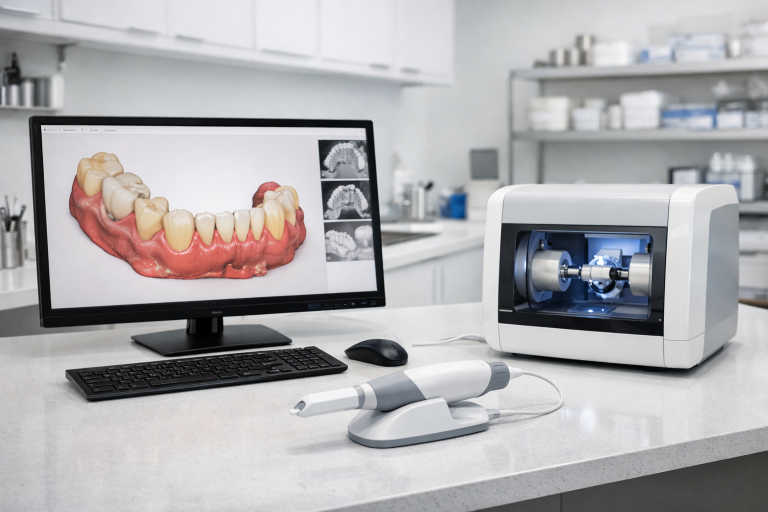
Additionally, the modularity and scalability of most CAD/CAM systems make them advantageous for laboratories of all sizes, from boutique specialty centers to large production labs. With the ability to quickly switch between materials like zirconia, e.max, or PMMA, laboratories can meet a broad spectrum of clinical needs without extensive downtime or process changes. This flexibility, paired with the reduction in manual touchpoints, ensures more consistent results and allows technicians to focus on quality control and complex artistry—areas that truly differentiate outstanding dental work.
Cloud-Based Platforms: Real-Time Collaboration
Effective case management in dental labs now relies heavily on cloud-based software solutions. Platforms such as DEXIS’ IS Connect Cloud eliminate the delays and communication breakdowns that once hindered case tracking, approval, and feedback. Digital files, treatment plans, and high-resolution scans can all be shared instantly and securely between dentists, specialists, and lab technicians. This seamless exchange improves both the quality and efficiency of care, with fewer shipment delays and less risk of lost or damaged models. Cloud-based systems ensure every stakeholder is updated in real time, resulting in optimal collaboration and case outcomes.
Furthermore, cloud platforms offer powerful data analytics tools that help laboratories monitor workflows, track trends, and identify areas for operational improvement. Automated record-keeping improves traceability and compliance, and the ability to access case data remotely provides greater flexibility for teams. As regulations evolve, particularly around data protection and patient privacy, the integration of secure cloud technologies helps laboratories remain compliant with minimal disruption to their processes.
Artificial Intelligence: Transforming Diagnostics and Workflows
Artificial intelligence is being integrated deeply into dental laboratory software and clinical decision-making processes. Solutions like DEXIS’ DTX Studio utilize AI-driven algorithms to swiftly analyze digital scans, radiographs, and clinical data. This speeds up diagnostics, highlights potential issues earlier, and helps prevent errors that can arise from purely manual assessments. For lab technicians, AI tools streamline repetitive tasks such as margin marking and tooth segmentation, making workflows more efficient and reducing time-to-delivery for restorative and orthodontic solutions. As implementation becomes more widespread, the role of AI in dental diagnostics and planning will only grow, helping laboratories achieve an unprecedented level of productivity and care quality.
AI is also beginning to enhance patient-specific customization, such as designing orthodontic appliances or prosthetics based on predictive outcomes. Machine learning systems can compare thousands of successful cases to recommend the best approach for new patients. As a result, dental labs are better equipped to handle complex scenarios and can offer more personalized treatments, solidifying their reputation as cutting-edge partners in dental care.
Challenges and Considerations in Digital Transformation
Transitioning to digital dental workflows is not without challenges. Labs must invest significantly in new equipment, software licenses, and employee training to fully adopt these technologies. There is also a growing need to prioritize data security and regulatory compliance, as sensitive patient information is transferred and stored online. Furthermore, integrating a variety of digital platforms, from different scanner brands to proprietary CAD/CAM or cloud solutions, can present compatibility and support issues that require ongoing management. Yet, despite these hurdles, the long-term rewards far outweigh the initial adjustments, particularly for laboratories focused on quality and growth.
To remain competitive, dental labs must also foster a culture of adaptability and continuous improvement. Open communication with partner dentists, ongoing education for staff, and proactive technology upgrades can mitigate some barriers associated with digital transitions. By viewing digital transformation as a journey rather than a one-time investment, laboratories are well-positioned to respond to industry changes and emerging patient needs, setting themselves up for sustained success.
Conclusion
The integration of advanced digital workflows is fundamentally reshaping dental laboratory operations. Technologies like digital impressions, CAD/CAM systems, cloud-based platforms, and AI-driven diagnostics are setting new benchmarks for accuracy, efficiency, and patient-focused care. Laboratories that embrace this technological evolution not only future-proof their practices but also deliver higher-value outcomes for both dental professionals and patients.
- 6 Bathroom Renovation Resources Spokane Homeowners Can Use for Safer, Easier-Care Spaces
- How R&D Center Helps People Find Personalized Drug Treatment in Philadelphia, Pennsylvania
- How Play Builds School Readiness for Preschoolers in Greensboro, North Carolina
- How to Choose the Right Way to Sell a House in Fayetteville, North Carolina
- Navigating Mental Health Resources and Therapy Options